

Perspective
In the composition of an image, perspective refers to the relationship between the objects in a photograph. This includes their relative positions and sizes and the space between them. In other words, perspective in the composition of a photograph is the way real three-dimensional objects are represented in a two-dimensional manner.
When taking pictures, the camera always creates perspective, so knowing the principles of perspective and skillfully applying them, can produce a photograph showing a good understanding of the subject’s form and shape, and the viewer is given the sensation of volume, space, depth, and distance.
The photographer can manipulate perspective to change the illusion of space and distance by either expanding or compressing these factors, therefore providing a sense of scale within the picture.
Linear Perspective
The human eye judges distance by the way elements within a scene diminish in size, and the angle at which lines and planes converge. This is called linear perspective. The distance between camera and subject and the lens focal length are critical factors affecting linear perspective. This perspective changes as the camera position or viewpoint changes. From a given position, changing only the lens focal length, and not the position of the camera, does not change the actual viewpoint, but may change the apparent viewpoint. The use of different focal lengths in combination with different lens-to-subject distances alters linear perspective in pictures.
When the lens-to-subject distance and lens focal length are both changed, the relationship between objects is altered and perspective is changed.
Dwindling Size Perspective
Through the experience of vision, we are aware of the size of many common objects, such as people, trees, cars, buildings, and animals. All these sizes vary, but for example, most adults are about 1.50m to 1.90m tall; therefore, when two people are shown in a picture and one appears twice as tall as the other, we cannot assume that one is in reality that much taller than the other. Instead we assume the taller person is closer and the shorter person farther away from the camera viewpoint. In this same manner, we make a size relationship evaluation of all familiar objects. Thus we can make a distance determination from this size relationship evaluation. The farther away an object is from the viewpoint, the smaller it appears; therefore, when objects of familiar size are included in a photograph, they help to establish the scale of the picture. Scale helps the viewer determine or visualize the actual size or relative size of the objects in the picture. There are numerous art photographers who simply play with this rule, placing smaller objects closer to confuse the viewer.For instance, there is widely known example of manipulating this perspective. Those are the tourist pictures in front of the Eiffel Tower or the Leaning Tower of Pisa. Often, tourists take photos to appear to support the tower from falling or holding in their palm the Eiffel Tower.
Focal-length and Perspective
There’s a bit more about the focal length than just the coverage of a certain angle of view – there’s always a distinct effect on the relationship between the objects within a scene. In the following photographs, I highlighted the size or rather the height of the door behind the model with a colored line. In each of the three photographs, the model does not change position or distance from the door. Additionally, the scene is cropped so that the door appears to be the same size in all three examples. The only thing that changes is the focal length and the distance of the camera from the model.


If we observe, we conclude that by zooming in, or increasing the focal length:
- the object closer to the camera occupies a larger space in the frame. Miss Vena, my model, occupies a much smaller space in the frame in relation to the door in the first picture than in the last picture.
- we reduce the effect of depth of space – the sense of distance of objects in the image – the door appears closer to the model in the first picture than in the last.
- the scene looks as if it is “compressed” or flattened. The scenery appears “shallower” in the first picture than in the last.
- we increase the depth of field. In the first photograph, you will see more details and a greater range of tones in the background even though the focus is on the portrait, and the aperture has not been changed – which directly affects depth of field.
- we reduce distortion, i.e., the curvature of space in perspective. Although there are not enough details in the background in the last picture, you will notice the curvature of the open door at the edge of the frame, which is absent in the first picture. This feature is extremely important when photographing portraits. Since wide-angle lenses “suck in” space, they deform it in such a way that they enlarge the area in the center and “compress” objects at the edges, they should be avoided in portrait photography. The nose looks swollen, the forehead looks longer, simply, the proportions are not realistic.
Rectilinear Perspective
Most lenses produce rectilinear perspectives that are typical of what the human eye sees. This is to say that straight lines in the subject are reproduced straight in the picture. But when a lens reduces three dimensions to two dimensions, not all geometric properties of the original scene are maintained. Distortions of straight lines can be produced with simple wide lenses, but they are more intense when using fisheye lenses and lenses used on panoramic cameras. A panoramic lens produces a panoramic or cylindrical perspective. In other words, all straight horizontal lines at the lens axis level are recorded as straight lines, and all other straight horizontal lines either above or below the lens axis level are reproduced as curved lines. Very similar to this is when mapping the shape of continents of our three dimensional globe onto a two dimensional map. The other false perspective is produced by a fisheye lens in which all straight lines in the subject are imaged as curved lines toward the edges of the picture.
Vanishing Point Perspective
In vision, lines that are parallel to each other give the sensation of meeting at vanishing points. When parallel lines, either horizontal or vertical, are perpendicular to the lens axis, the vanishing points are assumed to be at infinity. Other lines, those which are parallel to the lens axis, and all other parallel lines at all other angles to the lens axis meet at definable vanishing points. Thus lines that are parallel to the lens axis, or nearly parallel, start in the front of the picture and meet at vanishing points within the picture or at finite points outside the picture.

Height Perspective
The place where an object is located on the ground in a picture is a clue to its distance from the camera viewpoint. Let’s take an example: in a landscape scene, there are two dominant areas – the ground and the horizon. The higher up in the ground area of the picture (up to the horizon) that an object is located, the further away it seems from the viewpoint and the greater is height perspective. The height or, better say, the placement of objects in an image, is not the real height, but the visual impression of the height in the picture in relation to the horizon or its surroundings. This is a good tool when say, we want the image to evoke a feeling of loneliness, distance, leaving, alienation.Imagine a rectangular composition with two rectangles of the same size, placed at the same height in the frame. In this case we do not have any information or a sense of space or distance from the viewer. When one of rectangles is placed above the other, the impression of an apparent distance in relation to the observer is obtained.
Overlap Perspective
Another clue to distance in a photograph is overlapping. When objects within the picture are on about the same line of sight, those closer to the camera overlap more distant objects and partially hide them. It is obvious to the viewer that the partially obstructed object is behind the unobstructed object. This overlapping adds to the impression of spatial depth, even when the composition is very simple without many elements or the horizon, where the sense of space is minimal. Imagine a rectangular composition with two rectangles of the same size, placed at the same height in the frame. In this case, we don’t have any information or a sense of space or distance from the viewer. When one of the rectangles is placed so that partially overlaps the other, we get the immediate impression that the unhidden rectangle is closer to the viewer. This is the case even if though rectangles are of the same size, and even if the one overlapping is smaller that the other rectangle.
Volume Perspective
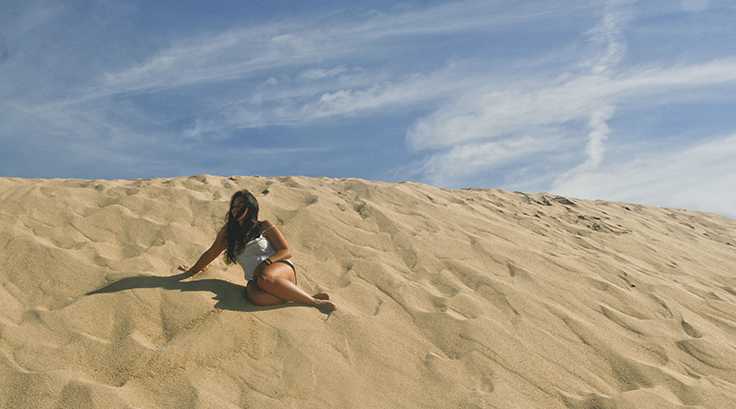
When a subject is lighted with very diffused light, the three-dimensional form or volume of the subject is difficult to perceive because of the lack of distinct shadows. If, on the other hand, subjects are lighted with strong directional light from angles that cause part of the subject to be fully lighted and other parts to be in shadow, a visual clue of the subject’s form or volume is provided. When a number of such objects are included within the picture area, the perception of form, volume, and depth is increased. When front or side lighting is used, the length, depth, and shape of the shadows cast on the ground provide a perspective of each object’s volume. Also, the distance between shadows cast on the ground helps us to perceive the overall depth of the scene.
Atmospheric Perspective
For all practical purposes, air is transparent. For most photography, this is fundamentally true; however, when pictures are made of subjects at great distances, the air is less than fully transparent. This is because air contains very fine particles of water vapor, dust, smoke and so on. These particles scatter light and change its direction. The presence of scattering shows distant subjects in pictures as having a veil or haze. The appearance or effect of this scattering is proportional to the distance of the objects from the viewpoint. The greater the distance, the greater the amount of veiling or haze. The effects of this scattering vary with atmospheric conditions and, when having in mind this influence, several factors should be considered:

- Contrast – The luminescence of each object in a scene is a direct result of the objects reflective quality and the amount of light falling on it. When objects are far away, light from highly reflective objects is scattered; therefore, when viewed from a distance or on a print, the darker portions of these distant objects do not appear as dark and the contrast is reduced. When there are objects both near and far from the camera, the difference in contrast provides a perception of distance.
- Brightness – The particles in air that scatter light are also illuminated by the sun. This causes an increase in the overall brightness of the objects seen. This increase in luminescence, coupled with a loss of contrast, causes objects in the distance to be seen and photographed as lighter in color than they would be at a closer distance
- Color saturation – The scattering of light not only affects contrast and brightness but also color saturation.Color is defined by three qualities: hue, saturation, and brightness. A pure hue is fully saturated. When a hue is unsaturated, it is no longer pure but has gray within. Colors of a distant scene appear to have less color saturation, because the light is scattered and also because of the overall presence of the unsaturated light of aerial haze. The original scene colors appear less saturated or pure when seen or photographed from a distance than from close-up; therefore, color saturation or desaturation allows the viewer to perceive distance in a color photograph.
- Sharpness – Because of atmospheric haze, there is a loss of image sharpness or definition in distant objects. This loss of sharpness is caused both by the lowering of contrast and the scattering of light. The loss of sharpness contributes to a sense of distance. This can be enhanced by setting the far limit of the lens depth of field just short of infinity. This procedure throws the most distant objects slightly out of focus. This combined with the other effects of aerial perspective intensities the sense of distance.
All photos on this page are mine and I own the copyright. These texts were created for my work in photography course in French school in Belgrade. I wrote this text probably under the influence of other websites or books about photography and references can be found in the footer of each post.
References:
http://photoinf.com/General/NAVY/Perspective.htmhttp://photoinf.com/General/Klaus_Schroiff/Perspective.htm
http://www.digitalphotographytipsonline.com/perspective-in-photography.html
http://www.arri.com/camera/tutorials/what_is_rectilinear_what_is_a_fisheye.html


